I feel like I've been a little hard on the French lately—accusing them of forming clumps and not lines and detailing the horrors of my particular experience with French banks. But let me take a moment to tell you something that I find extremely admirable chez les Français, because for all their quirks, I do love the French. (I did, after all, choose to live in France.)
Public transportation in France is a great thing. I don't have a car, and aside from the weekends when my fiancé travels home from school and drives me around in his tiny, neon green Nissan Micra, I exist solely on buses, trains, trams, and metros. I can go anywhere I need, nearly whenever I need to go there.
However, when I look around, I notice that public transport can be really difficult for anyone with a physical handicap, with a child in a stroller, or with luggage. Sure, some stations are equipped with elevators, but many aren't. The stations that aren't handicapped accessible have a whole lot of stairs to climb, and believe me, when you're lugging a suitcase around, navigating these stations can be pénible.
But here's the good part of living in France: all those perfectly coiffed French men whizzing past you in their black suits and thin ties heading to or from work will often wordlessly bend over, grab the edge of your baby carriage or the handle of your suitcase, and help you maneuver those stairs. You'll shout merci at their backs, but they'll keep walking. It's all in a day's work.
The other day, I took a train from Nogent to Pontault. I was traveling in the middle of the day, and there were only a handful of people on the train. I got off at my stop and vaguely noticed another three people get off at the same stop, all of them wheeling along their luggage.
We came to the stairs, and it was just me and these three people and their inordinate amount of luggage. Our three friends were attempting to make it down the stairs with three large suitcases, one dog in a carrier, and if we're being honest, lots and lots of body fat.
I stood at the bottom of the stairs and watched them for a second. I felt bad, so climbed back up the stairs and offered my help. They eyed me dubiously, but one of the group, an older woman, handed me her suitcase and said “Merci.”
I grabbed the handle and started walking the suitcase down the stairs. What I didn't take into consideration was the fact that the stairs had been recently cleaned and were still quite wet. Also, I was wearing my tiny black ballet flats that slide on any wet or dry, inclined or flat, natural or man-made surface. So, not surprisingly, only a few steps down, my foot slipped, and I slid down the stairs.
I landed on my back just outside the turnstiles, wriggling around like a beetle. The woman who's case I was still holding came flying down the stairs after me, calling, “Are you all right? Are you all right?”
I was fine. A little humiliated, but fine.
She took my arm and helped me up. She said, “Oh dear. Now that isn't how you carry a suitcase.” She shook her head, “It isn't how you do it at all.” She righted the suitcase, took the handle, and demonstrated. “You need to lift from your legs, not your back.”
I took the suitcase, mimed her movement, and she nodded.
I dragged the suitcase through the turnstiles and waited on the other side for the woman and her fellow travelers to make it through. The two women made it through just fine—pas de problème—, but the man waited on the other side with the remaining suitcases and the dog. He reached the dog over the turnstile and dropped it on the other side. The dog howled. The ladies screamed and rushed over to the animal carrier.
“Why would you do that?” one yelled. “You just dropped him!”
“Oh,” he said. That was it. Just “oh.”
One woman picked up the dog and then there was a lot of shuffling and arguing and pushing until the suitcases and the man passed through onto the other side. We divided the luggage between us and staggered up the last set of stairs, onto street level. Once there, the vocal lady of the group said to a security guard standing by the gate, “A town of this size should really have an elevator.”
“We do,” he said, pointing to the opposite exit. “Over there.”
All of them turned to look at me, and I blushed. “I didn't know,” I said. "I promise I didn't know." I apologized and hurried off home.
Next time I'll know, though, because, you see, France is a wonderful place, full of public transportation, helpful, well-coiffed Frenchmen, and at times, even elevators.
Tuesday, September 14, 2010

Monday, September 13, 2010
Immigrant Tales of the Bank
I pretty much hate my bank. Each time I go, something horrible happens, and I leave crying about how imbecilic, awkward, and unFrench I am.
Last year, I opened an account for a variety of reasons. For health insurance reasons, I needed an account. For tax reasons, I needed an account. For pay check reasons, I needed an account. So I went in, sat down with the banker, and understood about 14% of what he said (I did catch, “How in the world do you live on this little money?!) And a few months after this meeting, once my French level was a little higher and I started receiving bank statements in the mail, I realized I'd signed up to open all sorts of things that day. Quelle surprise!
A while after, I went to the bank to try and figure out how to transfer money from my debit account into this newly discovered savings account. The teller at the front desk was a young girl, very pretty, nice clothes...someone you'd expect to see in Paris. So, I patted down my hair, straightened my shirt, and walked up and told her I'd like to transfer money. Of course, I have the impression that my request wasn't as clear or direct as I'd hoped. I imagine it was more of a, “Good day, lady, I think transfer money be good idea.”
She laughed at me, took my card, typed in some information, laughed some more and then asked me a question I didn't understand at all.
I told her I didn't understand.
Agitated, she repeated the question, not slower, only louder.
I lowered my head and explained that I still didn't understand. She shouted the question this time, and by this point, everyone in the bank was looking at me. Then she said that typical French phrase that every French person I know says on a regular basis, C'est pas possible ça! (In France, you see, everything is either not possible or not normal.) I left the bank that day, determined to wean myself off money and never go to the bank again. Later that day, I went to the bank once all the employees were gone and checked my account information from the self-help machine. There was only one euro in my account. The accountant had forgotten to pay me. No wonder she'd laughed.
So, after this (and after another embarrassing debacle where I was so surprised to see money in my account that I ran all the way home and forgot my debit card in the machine. You can imagine how excited the teller was to see me wander back in, head lowered, and say, “Me lose card”), Stephan, my then-boyfriend (now fiancé!), and I hatched a brilliant plan. We'd stagger our entrances into the bank—I'd go in first, he'd count to ten and come in and wait in line after me. I'd do something completely ridiculous, the teller would yell at me, I'd wander out humiliated. Then, Stephan would walk up to the counter, and in his perfect, native speaker French, he'd say, “Well, I had considered opening an account here today, but after seeing how you treat your clients, I'm afraid I'll have to look elsewhere.” It was, admittedly, one of our better formed plans, but we never got around to it. Unnecessary trips to the bank aren't really my style.
A week ago, I got a very official looking envelope in my mailbox. Something very French governmental looking. I opened it and found a tax return inside. The check's arrival was bittersweet.
I put the check on my desk, in my To Do pile, and left it for a day. I looked over at it occasionally but never made any move to do anything about it.
I'd never received a check in France before. What was I supposed to do with it? In the States, I could deposit a check blindfolded. I could even cash the said check blindfolded and with both hands tied behind my back. In France? Well, my track record at the bank has never been so good.
Eventually, I got up my courage and walked into the bank, head bowed, embarrassed as always. But when I got to the desk, I noticed that there was a new teller. She was older than the other teller, less fashionable, but then, this is the Paris area, so let's face it: she was looking good.
I put the check on the desk, explained that i wanted to deposit it in my account, but wasn't sure how to go about doing this. I waited for her to tell me how abnormal or impossible this was.
But she didn't. She asked me to write down my account number and to sign below. I did. And then, she said, “Merci. Have nice day.” I stood there, didn't leave, and finally said, “That's all?”
“Oui,” she replied, “That's all you have to do.”
So, that was it. A pleasant trip to the bank. No humiliation.
I passed by everyday last week to look in and see who's working. My banking nemesis hasn't been back. I'm left to wonder: is this vacation? Or is this a permanent vacation?
I can't say I'm terribly broken up about her absence.
However, I'm hesitant to get too optimistic. My banker called Friday. He wants me to come in this Friday to discuss my banking needs. What banking needs? I'm not sure. But I'm hoping for the best, and I'm listening to all my “Pronounce it Perfectly” CDs in the hope that my bank humiliation is over forever.
Last year, I opened an account for a variety of reasons. For health insurance reasons, I needed an account. For tax reasons, I needed an account. For pay check reasons, I needed an account. So I went in, sat down with the banker, and understood about 14% of what he said (I did catch, “How in the world do you live on this little money?!) And a few months after this meeting, once my French level was a little higher and I started receiving bank statements in the mail, I realized I'd signed up to open all sorts of things that day. Quelle surprise!
A while after, I went to the bank to try and figure out how to transfer money from my debit account into this newly discovered savings account. The teller at the front desk was a young girl, very pretty, nice clothes...someone you'd expect to see in Paris. So, I patted down my hair, straightened my shirt, and walked up and told her I'd like to transfer money. Of course, I have the impression that my request wasn't as clear or direct as I'd hoped. I imagine it was more of a, “Good day, lady, I think transfer money be good idea.”
She laughed at me, took my card, typed in some information, laughed some more and then asked me a question I didn't understand at all.
I told her I didn't understand.
Agitated, she repeated the question, not slower, only louder.
I lowered my head and explained that I still didn't understand. She shouted the question this time, and by this point, everyone in the bank was looking at me. Then she said that typical French phrase that every French person I know says on a regular basis, C'est pas possible ça! (In France, you see, everything is either not possible or not normal.) I left the bank that day, determined to wean myself off money and never go to the bank again. Later that day, I went to the bank once all the employees were gone and checked my account information from the self-help machine. There was only one euro in my account. The accountant had forgotten to pay me. No wonder she'd laughed.
So, after this (and after another embarrassing debacle where I was so surprised to see money in my account that I ran all the way home and forgot my debit card in the machine. You can imagine how excited the teller was to see me wander back in, head lowered, and say, “Me lose card”), Stephan, my then-boyfriend (now fiancé!), and I hatched a brilliant plan. We'd stagger our entrances into the bank—I'd go in first, he'd count to ten and come in and wait in line after me. I'd do something completely ridiculous, the teller would yell at me, I'd wander out humiliated. Then, Stephan would walk up to the counter, and in his perfect, native speaker French, he'd say, “Well, I had considered opening an account here today, but after seeing how you treat your clients, I'm afraid I'll have to look elsewhere.” It was, admittedly, one of our better formed plans, but we never got around to it. Unnecessary trips to the bank aren't really my style.
A week ago, I got a very official looking envelope in my mailbox. Something very French governmental looking. I opened it and found a tax return inside. The check's arrival was bittersweet.
I put the check on my desk, in my To Do pile, and left it for a day. I looked over at it occasionally but never made any move to do anything about it.
I'd never received a check in France before. What was I supposed to do with it? In the States, I could deposit a check blindfolded. I could even cash the said check blindfolded and with both hands tied behind my back. In France? Well, my track record at the bank has never been so good.
Eventually, I got up my courage and walked into the bank, head bowed, embarrassed as always. But when I got to the desk, I noticed that there was a new teller. She was older than the other teller, less fashionable, but then, this is the Paris area, so let's face it: she was looking good.
I put the check on the desk, explained that i wanted to deposit it in my account, but wasn't sure how to go about doing this. I waited for her to tell me how abnormal or impossible this was.
But she didn't. She asked me to write down my account number and to sign below. I did. And then, she said, “Merci. Have nice day.” I stood there, didn't leave, and finally said, “That's all?”
“Oui,” she replied, “That's all you have to do.”
So, that was it. A pleasant trip to the bank. No humiliation.
I passed by everyday last week to look in and see who's working. My banking nemesis hasn't been back. I'm left to wonder: is this vacation? Or is this a permanent vacation?
I can't say I'm terribly broken up about her absence.
However, I'm hesitant to get too optimistic. My banker called Friday. He wants me to come in this Friday to discuss my banking needs. What banking needs? I'm not sure. But I'm hoping for the best, and I'm listening to all my “Pronounce it Perfectly” CDs in the hope that my bank humiliation is over forever.
Keeping it Real
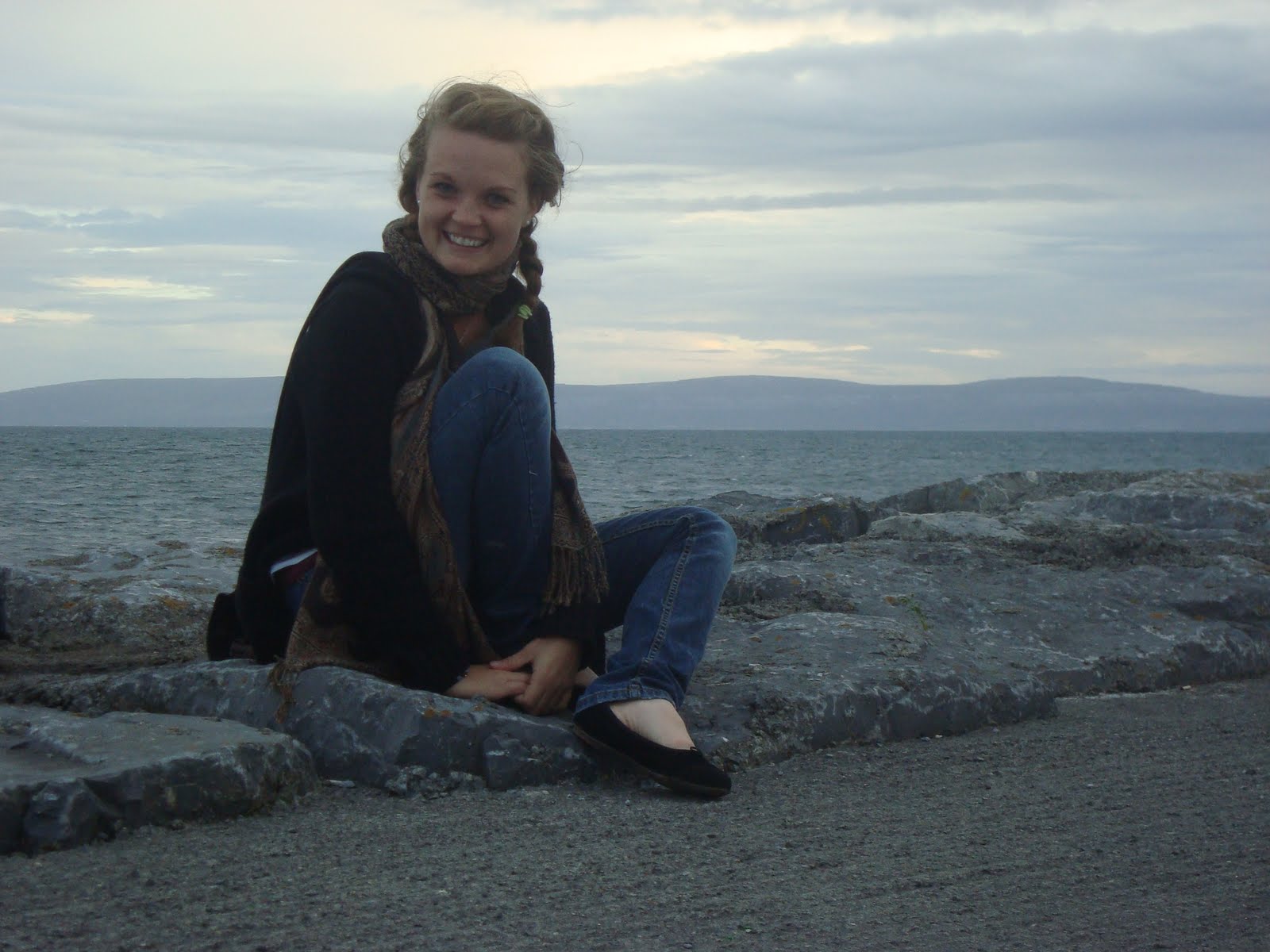

It's been a long-term goal of mine to go to Ireland one day, and would you know, last week, that dream came true. I booked a Ryanair flight and flew off to see the world (or rather, a part of it). I spent a day in Galway and two days in Dublin. While I was there, I had many a cup of tea, saw Galway's St. Nicolas Church, Galway Cathedral, Lynch's Castle and Spanish arches. I walked the promenade and sat by Galway Bay, feeding the swans. In Dublin, I visited Trinity College where I got a peak at the Book of Kells, that illustrated copy of the four Gospels written by monks in the 8th century. I saw Christ Church Cathedral and Kilmainham Gaol and visited the Dublin Writer's museum.
It was a perfect three-day trip.
But what's funny is that, even in Ireland, I didn't quite lose the French people.
My second day, I arrived at the Galway bus station about a half-hour early to board my bus and to head back to Dublin. As the Irish arrived, they lined up one by one behind me, quiet and unassuming.
Then this group of backpackers arrived, pushed past everyone, and camped right next to the bus door. They looked at each other and, wonder of wonders, started speaking French.
I had to laugh.
In my experience, I've noticed that the French don't really know what a line is. When you go to the préfecture, they wrestle their way to the front of the lines. When I was at a crepe party at church, I stood back at what I thought was the end of the line, and everyone elbowed past me. Eventually, a friend of mine said, "If you don't shove your way to the front, you'll never eat." At the airport, making it past security is a nightmare with everyone forming clumps instead of single-file lines.
But then, C'est la Vie. That's the French.
It's good to see the French keeping it real.
Wednesday, September 1, 2010
Life with Levy
I've recently launched an effort I like to call “Operation: Read More Books in French.” I've been in France for a year and a half and have read exactly three books in French. Two of the books I've read are Pierre Bellemare books made up of two-page unsolved mystery type stories. The other book, I learned (much to my chagrin), is a translation of an already existing English book. So, not only am I gaining no new French vocabulary words (with the exception of fouiller. The policemen in Bellemare's books are perpetually fouiller-ing through other people's things), I'm also learning nothing about French culture.
So, this past week, I decided to aborde that problem (oh wait, look at that: another new French word) and start reading a novel by France's most widely read author, Marc Levy. Levy, on a side note, wrote the novel that was adapted into Reese's Witherspoon's movie, Just Like Heaven. So, I started with Levy's La Prochaine Fois, a book that looked reasonably short. It's the story of two people on a mission to find a toile. Problem: I bought the book at a book stand in the train station and started reading on the way home. I didn't have a French dictionary with me and couldn't figure out what a toile was or why these two would-be lovers were looking for one. Eventually, I asked my fiancé, had him read the back and explain the premise of the book to me, and all the puzzle pieces fell into place. (“Ohhhhh...they're searching for a missing painting...”)
Ever since I've started reading Levy, I've felt a certain camaraderie with Marc Levy readers everywhere (and believe me, they are everywhere). My first day reading La Prochaine Fois, I noticed a woman in the train reading a Levy book. She smiled at me, held her book up so I could see the cover, and I nodded politely but cooly, as if to say, “Nice, but no big deal. I read Marc Levy all the time.”
My entry into the Marc Levy world also seems to gain me entrance into the normally very closed and private French life. I was taking a class in Nogent last week, and a women from class picked me up from the train station. She saw La Prochaine Fois in my hand and said, “Oh, such a good book. Really helped me through a messy breakup.” She then proceeded to give me all the details of that relationship gone wrong.
And Marc Levy has expanded my vocabulary—not only from reading his literature, but also from discussing his books with people around me. A friend of mine saw the book sitting on my desk in class and said, “Marc Levy, huh? He's interesting but his stories ne sont pas trop Catholiques.”
His stories aren't too Catholic?
I looked up the phrase pas trop Catholiques in my dictionary, and found that the expression means a little bit fishy, not quite right. Apparently the phrase can be applied to foods, to actions, and to Marc Levy plots. So, I've started using the phrase as often as possible.
At lunch the other day, the cook brought out slabs of sausages rolled inside zucchini. I leaned over to the girl next to me and proclaimed the meal not too Catholic. When listening to a friend describe an interaction with the civil servants at the prefecture, I assured her that their behavior wasn't too Catholic. And later, I was reading in an old newspaper about some scandalous activity between monks and nuns. This too I deemed not too Catholic.
But now, I've finished La Prochaine Fois, and unfortunately (or fortunately, depending on how you look at it), my library just got a shipment of Lorrie Moore books in English. So, I might have dropped “Operation: Read More Books in French” for the moment. Although, on my way home today, I saw the cover of Levy's Toutes ces choses qu'on ne s'est pas dites, and I think it's time to get back into Levy mode. No one in France seems to know Lorrie Moore. And frankly, I miss the friendly Levy-lover faces on the train.
So, this past week, I decided to aborde that problem (oh wait, look at that: another new French word) and start reading a novel by France's most widely read author, Marc Levy. Levy, on a side note, wrote the novel that was adapted into Reese's Witherspoon's movie, Just Like Heaven. So, I started with Levy's La Prochaine Fois, a book that looked reasonably short. It's the story of two people on a mission to find a toile. Problem: I bought the book at a book stand in the train station and started reading on the way home. I didn't have a French dictionary with me and couldn't figure out what a toile was or why these two would-be lovers were looking for one. Eventually, I asked my fiancé, had him read the back and explain the premise of the book to me, and all the puzzle pieces fell into place. (“Ohhhhh...they're searching for a missing painting...”)
Ever since I've started reading Levy, I've felt a certain camaraderie with Marc Levy readers everywhere (and believe me, they are everywhere). My first day reading La Prochaine Fois, I noticed a woman in the train reading a Levy book. She smiled at me, held her book up so I could see the cover, and I nodded politely but cooly, as if to say, “Nice, but no big deal. I read Marc Levy all the time.”
My entry into the Marc Levy world also seems to gain me entrance into the normally very closed and private French life. I was taking a class in Nogent last week, and a women from class picked me up from the train station. She saw La Prochaine Fois in my hand and said, “Oh, such a good book. Really helped me through a messy breakup.” She then proceeded to give me all the details of that relationship gone wrong.
And Marc Levy has expanded my vocabulary—not only from reading his literature, but also from discussing his books with people around me. A friend of mine saw the book sitting on my desk in class and said, “Marc Levy, huh? He's interesting but his stories ne sont pas trop Catholiques.”
His stories aren't too Catholic?
I looked up the phrase pas trop Catholiques in my dictionary, and found that the expression means a little bit fishy, not quite right. Apparently the phrase can be applied to foods, to actions, and to Marc Levy plots. So, I've started using the phrase as often as possible.
At lunch the other day, the cook brought out slabs of sausages rolled inside zucchini. I leaned over to the girl next to me and proclaimed the meal not too Catholic. When listening to a friend describe an interaction with the civil servants at the prefecture, I assured her that their behavior wasn't too Catholic. And later, I was reading in an old newspaper about some scandalous activity between monks and nuns. This too I deemed not too Catholic.
But now, I've finished La Prochaine Fois, and unfortunately (or fortunately, depending on how you look at it), my library just got a shipment of Lorrie Moore books in English. So, I might have dropped “Operation: Read More Books in French” for the moment. Although, on my way home today, I saw the cover of Levy's Toutes ces choses qu'on ne s'est pas dites, and I think it's time to get back into Levy mode. No one in France seems to know Lorrie Moore. And frankly, I miss the friendly Levy-lover faces on the train.
Monday, August 30, 2010
Home again, home again...

Here I am, back in Pontault after a very long summer. There were a lot of really fun days and a lot of really rough ones. I laughed a lot and cried a lot, as tends to be the case when you live in a room with nearly 20 other girls and all share the same shower (see attached photo).
But yes, now I'm back and preparing to head back to school in September. But before I head back into literacy mode, I wanted to think of one story from the summer to share with you, and I think I've finally thought of the perfect moment.
It was a Saturday in the hottest part of the summer. My team and I were headed door to door to invite people to the music festival that our church was hosting. I headed out alone, because there was an uneven number of us. I only had a few streets on my map, so it shouldnt have taken long. But going door to door in France is never, as the French say, evident.
French houses are so interesting. You don't often just walk up to a door and ring, because the houses are surrounded by walls that are at least the same height as the house itself, if not taller. (I've heard that, back in the day, people were taxed based on how many possessions they had, and tax collectors would decide how much to charge by looking in the windows. Now French people barricade themselves away inside their homes in order to avoid paying taxes at all, it seems). So, anyway, all this to say, if you want to talk to the people living in the houses (which I did), you have to ring the little bell outside the gate, and if you're in the south (which I was), you immediately start praying really hard. Why? Because everyone in the south has a huge sign on their gate reading Beware of Dog, or even, in some case, Beware of Cat. Then, after ringing the bell, these huge monstronsities of animals come leaping at the gate, clawing, biting, barking, etc. Finally, the owner of the house comes out (in various states of undress: one man answered in a white, lacy, woman's nightgown; another woman answered in a towel) and you try not to look awkward as you hand them a program of events for the music festival and encourage them to come to the events.
Anyway, this particular Saturday that I mentioned, I was alone and tired and it was hot. And on top of all of this, I should really mention that I can't really read maps. I have zero sense of direction. I was looking for an Impasse that didn't seem to exist, and I wound over and over again through the same streets, reading street signs I'd already read and becoming extremely frustrated.
Eventually, I found a grouping of houses that wasn't listed on the map. I walked up, and would you know, there were no gates around any of these houses. No dogs. No cats. Just a circle of houses with children playing out in the yards. I thought, Why not?
I began the process of systematically knocking on every door and saying, Avez-vous déjà reçu cette invitation? And none of the people in the neighborhood had already received the aforementioned invitation, so I just kept going and going and going.
Eventually, one of the little boys that who had been riding his bike nearby approached me and said, "What are you doing?"
I told him I was inviting people to the festival at my church and he said, "Oh sounds fun. I want to do that too."
So he wheeled along beside me for moral support. We approached one door and he said, "This is an old man. He's not going to answer."
And sure enough, he didn't.
We approached another door, and he said, "This lady has two houses."
"Really?" I asked. "How's that?"
"She's never at hers. She's always next door with the man next door."
Sure enough, she didn't answer at her house, but did at the house next door.
After a while, the little boy called over his sister and friends who trawled along on their bikes behind me shouting out advice for each house I approached. And we had a great time. We invited the whole neighborhood, and when we finished, the boy said, "Let's go around again!"
I was so encouraged by his enthusiasm. Going door to door is hard and scary and often really, really monotonous. But it was so great to have had those kids with me, cheering for me and encouraging me.
That's how I'll remember the south this summer. It was often hard and scary and monotonous, but every step of the way, God sent those little reminders that He was there, taking care of me. Streams in the desert in the form of a 8 year old boy, I guess you could say.
Friday, August 6, 2010
Bonjour du Sud de la France!!
I haven't updated in a while...and for legitimate reasons... Things have been just a little bit out of the ordinary lately.
For one thing, I got engaged on July 17th. Stephan asked me to marry him at our favorite lake near Le Nautil in Pontault. We had one day to celebrate together, before I headed off to Rome on July 18th. I spent about a week in Rome training and preparing for our Transform 2010 Conference with OM. After this, I headed straight off to the South of France where I am currently leading outeaches in a few cities bordering on the Mediterranean (yeah, I know! Life's rough...). We're leading kids clubs, visiting retirement homes, and talking to nearly everyone in the villages nearby Codognan and Caveirac.
For the moment, I'm headed off to help with tonight's puppet show in the Municipal building.
I hope to update soon, but if not, expect to hear from me in September when I return to Pontault.
Bisous! xxx
For one thing, I got engaged on July 17th. Stephan asked me to marry him at our favorite lake near Le Nautil in Pontault. We had one day to celebrate together, before I headed off to Rome on July 18th. I spent about a week in Rome training and preparing for our Transform 2010 Conference with OM. After this, I headed straight off to the South of France where I am currently leading outeaches in a few cities bordering on the Mediterranean (yeah, I know! Life's rough...). We're leading kids clubs, visiting retirement homes, and talking to nearly everyone in the villages nearby Codognan and Caveirac.
For the moment, I'm headed off to help with tonight's puppet show in the Municipal building.
I hope to update soon, but if not, expect to hear from me in September when I return to Pontault.
Bisous! xxx
Friday, July 9, 2010
Inside a French Reitrement Home
So, let's start with the sad news: I've had to change my About Me section. I'm now a 25 year old Indianapolis native. Good grief. Getting old...
Summer here in the Paris always brings plenty of visitors. A few weeks ago, there were some 20 people living here at the house. (Thankfully, that was only temporary, and now, we're settled into the more pleasant 4 housemate situation). But now, at my church in the Paris banlieue, a group of Canadians have come through to help us with some of our church tasks.
Yesterday, we all headed to a Catholic-run retirement home in Noisy. Before going, we were informed that the living situation at this home would be quite different from the living situations in retirement homes in the States and Canada. I know retirement and nursing homes. I worked almost 6 years in a retirement home in Fishers, Indiana. We called it The Palace. It had lush carpets, chandeliers, and a pretty hefty monthly fee. But I also did marketing for this particular retirement home, and so, I'd traveled around to the surrounding homes. I'd seen the bottom of the barrel (the state-run, Medicare and Medicade paid homes) and the cream of the crop (the private pay homes where one had to wear a suit or dress to dinner).
But the home we went to yesterday was like any retirement home I'd ever seen. The aides and employees all seemed very cheerful and kind to the residents, but the home itself looked like a church from the outside, with its wooden paneling and crosses carved into the walls, but a hospital on the inside. It was very basic, very sterile, very un-homelike.
We brought along our instruments and our plates of diabetic friendly and unfriendly cookies.
I played a few songs on the flute, and actually had difficulty focusing, because the woman in the front row kept tossing me kisses and exclaiming about how wonderful it was to have music. We also had trumpet and guitar music and we sang a variety of songs.
After, we wandered around and greeted everyone. I talked a long while with a woman who usd to work with her husband in a pharmacy. She hadn't been licensed, but still sorted pills and did odd jobs for her husband. Once, her husband (who was a licensed pharmacist) had gone out to buy things for the store, and an inspector had come in. She's had to distract him for a good half hour or so until her husband had come back. She was just the most jolly woman. When they handed he a half full styrofoam cup of Coca Cla, she lifted it to the ceiling and started singing an old French drinking songs. And then, she started reminiscing about the old days--the days when she and her husband had gone walzing every night and worn their finest clothes.
There was another man there--an Albanian man who could speak any language. Once he heard I was from the States, he spoke to me in Engish. To his French nurses, he spoke French. To the Italian gardener, he spoke Italian. And apparently, although his memories are almost entirely gone, he can still speak 6 languages. It was really amazing.
The group of Canadians with us are all actually Chinese-Canadians. They began speaking to a few of the Chinese residents in Cantonese, and the residents' faces lit up and they all replied in Cantonese. One Vietnamian man even started speaking Cantonese with them, followed us out to the car, and begged to come with us. That was actually quite sad. I hate that part. The leaving part.
When I stand there in a home like that, I always start thinking about how it'll be for me in 50 years or so. Where will I be? What will I be doing? I'm not so keen to think about that...
In the meantime, however, the director asked those of us living in the Paris area to come back and play our instruments as often as possible. I said I'd really like to come back and play some more songs on my flute. Maybe I'll even get my ukelele up to speed and bring that along.
I'd love to go back and learn more about the almost-pharmacist, the Albanian polyglot, and all the others.
Summer here in the Paris always brings plenty of visitors. A few weeks ago, there were some 20 people living here at the house. (Thankfully, that was only temporary, and now, we're settled into the more pleasant 4 housemate situation). But now, at my church in the Paris banlieue, a group of Canadians have come through to help us with some of our church tasks.
Yesterday, we all headed to a Catholic-run retirement home in Noisy. Before going, we were informed that the living situation at this home would be quite different from the living situations in retirement homes in the States and Canada. I know retirement and nursing homes. I worked almost 6 years in a retirement home in Fishers, Indiana. We called it The Palace. It had lush carpets, chandeliers, and a pretty hefty monthly fee. But I also did marketing for this particular retirement home, and so, I'd traveled around to the surrounding homes. I'd seen the bottom of the barrel (the state-run, Medicare and Medicade paid homes) and the cream of the crop (the private pay homes where one had to wear a suit or dress to dinner).
But the home we went to yesterday was like any retirement home I'd ever seen. The aides and employees all seemed very cheerful and kind to the residents, but the home itself looked like a church from the outside, with its wooden paneling and crosses carved into the walls, but a hospital on the inside. It was very basic, very sterile, very un-homelike.
We brought along our instruments and our plates of diabetic friendly and unfriendly cookies.
I played a few songs on the flute, and actually had difficulty focusing, because the woman in the front row kept tossing me kisses and exclaiming about how wonderful it was to have music. We also had trumpet and guitar music and we sang a variety of songs.
After, we wandered around and greeted everyone. I talked a long while with a woman who usd to work with her husband in a pharmacy. She hadn't been licensed, but still sorted pills and did odd jobs for her husband. Once, her husband (who was a licensed pharmacist) had gone out to buy things for the store, and an inspector had come in. She's had to distract him for a good half hour or so until her husband had come back. She was just the most jolly woman. When they handed he a half full styrofoam cup of Coca Cla, she lifted it to the ceiling and started singing an old French drinking songs. And then, she started reminiscing about the old days--the days when she and her husband had gone walzing every night and worn their finest clothes.
There was another man there--an Albanian man who could speak any language. Once he heard I was from the States, he spoke to me in Engish. To his French nurses, he spoke French. To the Italian gardener, he spoke Italian. And apparently, although his memories are almost entirely gone, he can still speak 6 languages. It was really amazing.
The group of Canadians with us are all actually Chinese-Canadians. They began speaking to a few of the Chinese residents in Cantonese, and the residents' faces lit up and they all replied in Cantonese. One Vietnamian man even started speaking Cantonese with them, followed us out to the car, and begged to come with us. That was actually quite sad. I hate that part. The leaving part.
When I stand there in a home like that, I always start thinking about how it'll be for me in 50 years or so. Where will I be? What will I be doing? I'm not so keen to think about that...
In the meantime, however, the director asked those of us living in the Paris area to come back and play our instruments as often as possible. I said I'd really like to come back and play some more songs on my flute. Maybe I'll even get my ukelele up to speed and bring that along.
I'd love to go back and learn more about the almost-pharmacist, the Albanian polyglot, and all the others.
Subscribe to:
Posts (Atom)
